
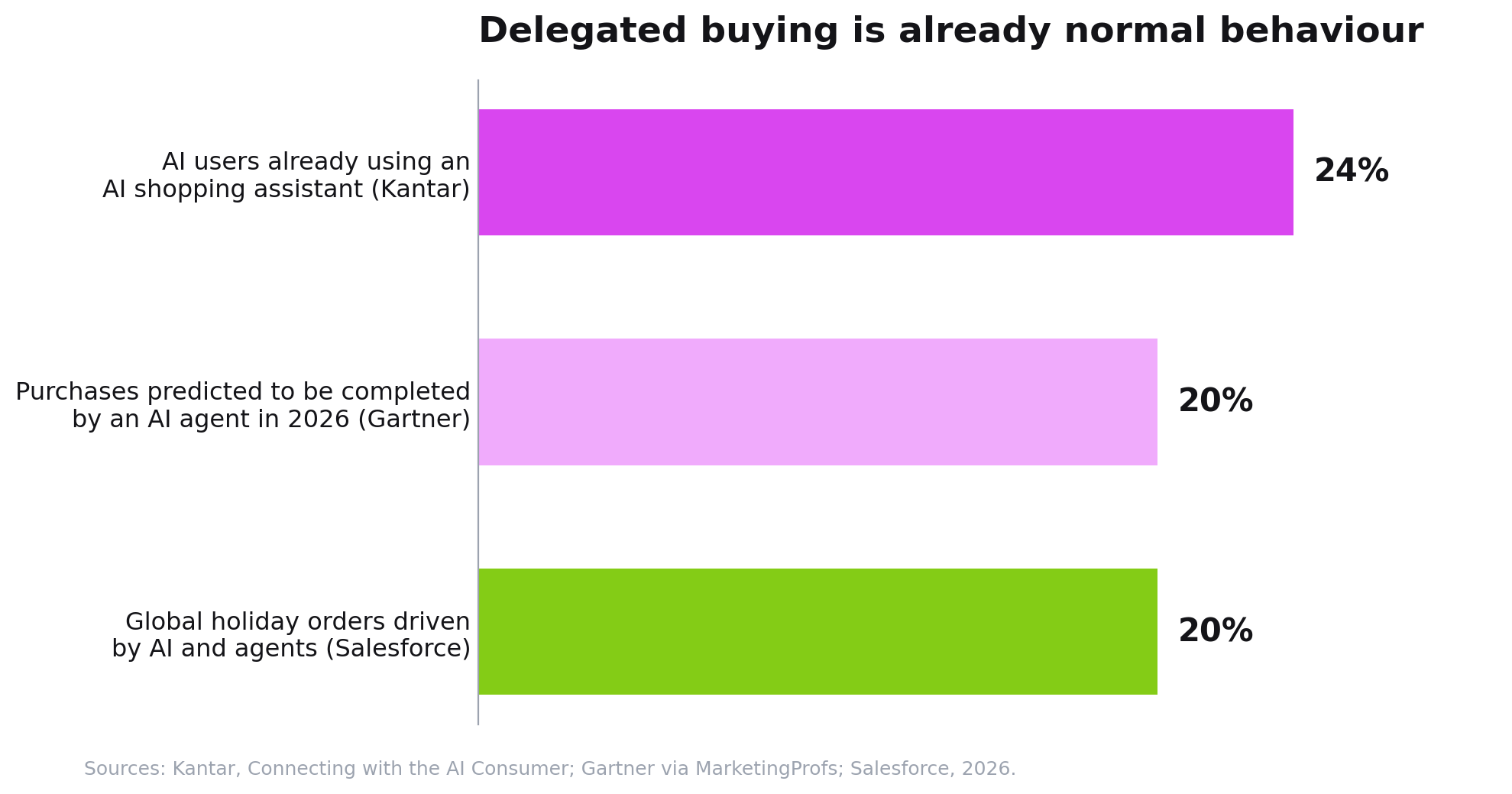
Gartner predicts one in five purchases will be completed by an AI agent this year, a quarter of AI users already lean on a shopping assistant, and AI influenced 20% of global online sales over the 2025 holiday season. Marketing has spent a century learning to persuade humans, and now it also has to be legible to machines - which most brands aren't.
Somewhere in the next year or so, a ticket to a Saturday matinee will be bought by something that has never seen a play. A person will say to their assistant, "find us something good on Saturday afternoon, aisle seats, under £40 each," and an AI agent will check the listings, compare the options, and complete the purchase. The customer will enjoy the show, and the agent, which cannot enjoy anything, will have made the decision.
That sounds like science fiction right up until you look at the numbers. Gartner predicts that one in five purchases will be completed by an AI agent in 2026, and Kantar's research found that 24% of AI users are already using an AI shopping assistant in some form. Salesforce's own commerce data makes it concrete: over the 2025 holiday season, AI and agents influenced 20% of global online sales, worth $262 billion. The behaviour is arriving faster than most marketing plans are, and nobody gets to sit this one out.
Machines don't feel anything about your brand
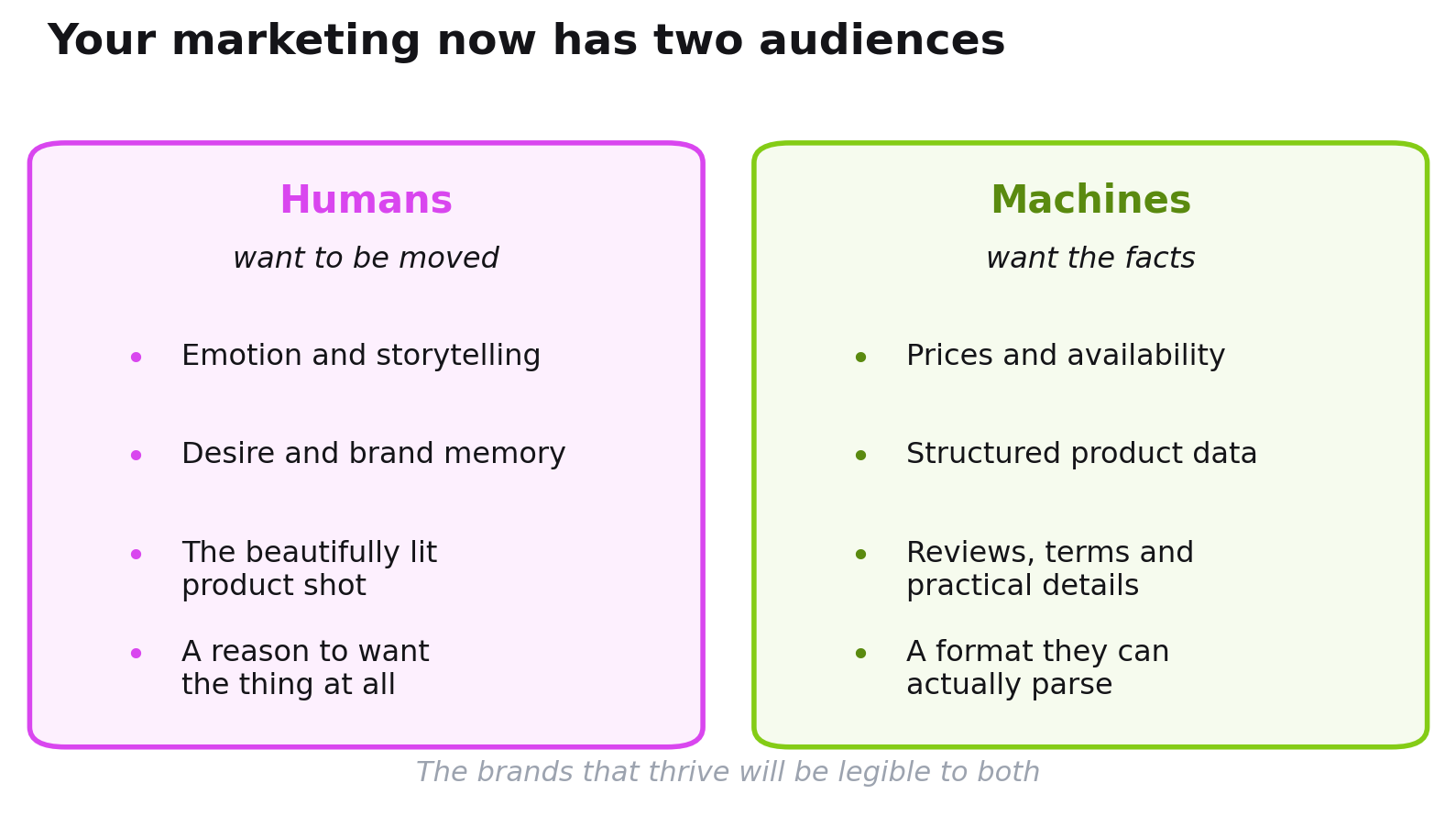
Everything marketing has learned in a century - emotion, storytelling, desire, the warm glow of a beautifully lit product shot - is aimed at a human nervous system. An AI agent doesn't have one. Research covered in Harvard Business Review found that the classic persuasion tactics built for human psychology - scarcity, countdown timers, strike-through pricing - do not reliably influence AI shopping agents, which means your product content has to be structured so a machine can find it and read it. Given the brief "aisle seats under £40," an agent wants your prices, your seat map, your availability and your refund policy, and it wants to find them in a format it can actually use.
This creates a strange new requirement, which is that your marketing now has two audiences with opposite tastes. Humans want to be moved. Machines just want the facts, laid out somewhere they can parse them. Kantar frames the CMO's new job rather elegantly: brands have always needed to predispose people, and now they need to predispose agents too. The new job is serving both at once: as lovable to the person as ever, and perfectly parseable to the software acting on that person's behalf.
None of this means the emotional layer stops mattering. A person still has to want the thing before they delegate the buying of it, and brand memory is what puts you in the brief in the first place. What changes is that a new, ruthlessly literal gatekeeper now sits between that desire and the transaction.
What this looks like for a real business
Take a theatre. The romance of the season brochure does nothing for an agent. What the agent needs is show times, running length, pricing by seat band, access information and booking terms, published in a structure a machine can parse rather than buried in a PDF or locked inside an image. The pattern is already visible in local search, where assistants select a provider they can justify from structured information - business profiles, service descriptions, pricing, reviews, opening hours - rather than presenting a list of options. A theatre whose listings are machine-readable gets recommended, while one whose website is a beautiful, unparseable mystery quietly vanishes from journeys it never knew were happening.
Or take luxury retail. Collectors shopping for a vintage watch increasingly start their research by asking an AI a question - which reference, what movement, what a fair price looks like. An agent assembling that answer relies on structured product data: reference numbers, condition, provenance, price. The dealer whose inventory is legible to machines gets cited in the conversation where the decision is actually being made. The others are relying on the customer scrolling past organically, which is a strategy in the same way that hoping is a strategy.
The mechanics of making your content citable by AI systems - the discipline now called Generative Engine Optimisation, or GEO - are something we've already covered in practical detail, in both our guide to winning your first customers and our guide to your first 1000 users. I won't repeat the how-to here. What interests me is what comes after citation: agents that take the answer and then complete the transaction on their owner's behalf.
A word of caution before you rebuild everything
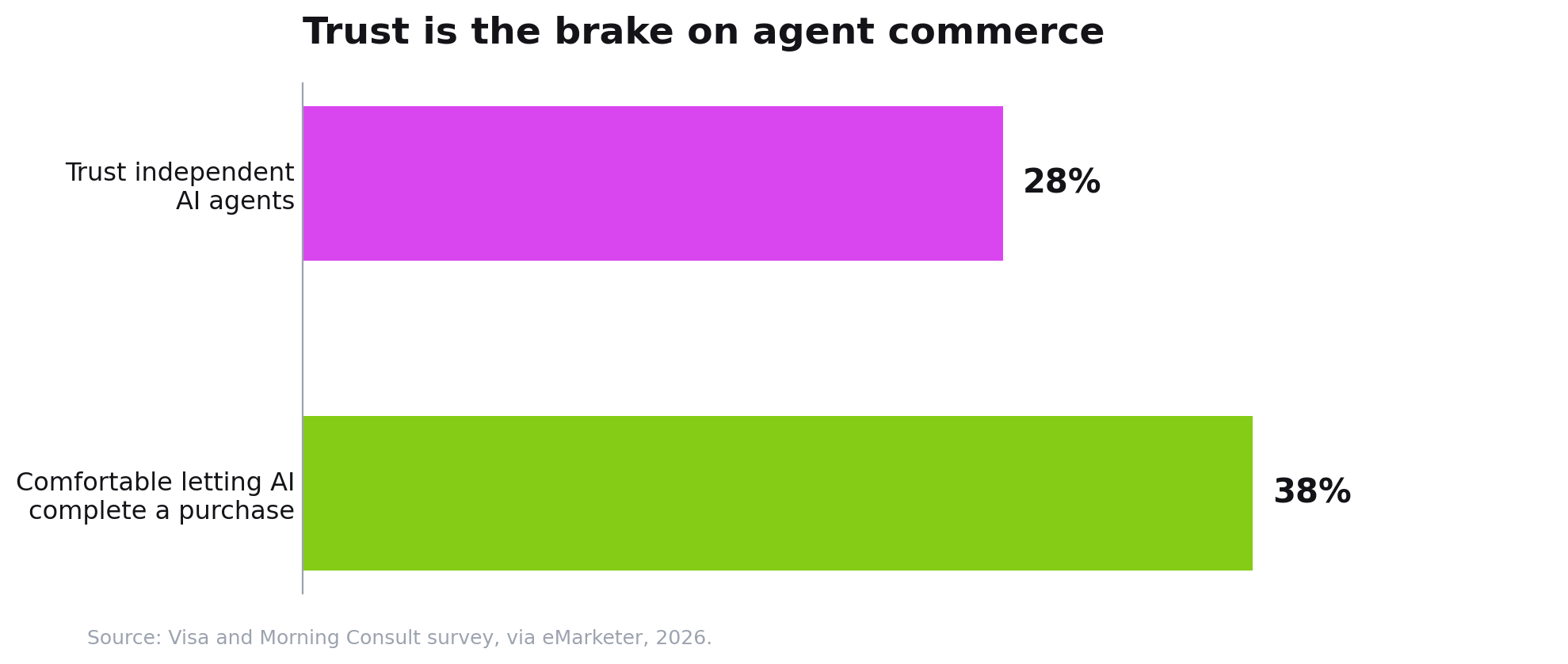
It would be dishonest to present this as a done deal. Consumer trust is the brake: a Visa and Morning Consult survey found only 28% of consumers trust independent AI agents, and 38% are comfortable letting AI complete a purchase - people are happy to delegate the research, less happy to delegate the credit card. The likeliest near-term pattern is agents shortlisting and humans confirming, which still means that being absent from the shortlist is fatal.
The research showing agents ignoring human sales tricks sits alongside research showing them responding to things no rational buyer would notice. A 2026 study found that simply framing a prompt with joy rather than fear improved accuracy on current models by up to 4.5 percentage points, confirming what a 2023 Microsoft-led study first showed, that encouragement as soft as "believe in your abilities" measurably lifts output quality. I have noticed it myself: encourage the model and the output visibly lifts, and if I did not know better I would call it enthusiasm.
The two findings are less contradictory than they look. These models are built out of human language, so they inherit our habits in statistical form - including, it seems, the habit of trying harder for someone who is encouraging. What that means for a brand is that an agent is not a spreadsheet with a credit card. Each model carries its own biases - in the shopping research, only star ratings and competitive pricing moved agents consistently, and everything else varied by model - so test how the specific agents your customers use actually respond to your content, rather than optimising for an imaginary perfectly rational buyer who does not exist on either side of the transaction.
And the timing will vary by sector: commodity purchases will tip first, while considered, emotional purchases will keep their human moment longer. But the research phase of even the most emotional purchase is already being delegated, and the research phase is where most buying decisions are quietly made.
So the practical move is unglamorous and quite cheap: audit your own legibility. The machine is now a customer too, and it deserves the same care you give the human one. Ask an AI assistant the questions your customers ask, and see whether you appear, and whether what it says about you is accurate. Check whether your prices, your products and your practical details exist anywhere a machine can read them. Google has just made part of this measurable, too: its new platform properties in Search Console show which search terms surface your Instagram, TikTok, X and YouTube content, so you can finally see how your social presence performs in search rather than guessing. Fix what's broken before your competitors work out that the same test exists.
Your next customer might well be a machine shopping on a human's behalf, and it will judge you on nothing but what it can read. Serve it as carefully as you serve the person who sent it.